The green room problem at conferences, and why one vehicle solves talent holding, sponsor hospitality and private meetings across the same event.
The green room problem at conferences, and why one vehicle solves talent holding, sponsor hospitality and private meetings across the same event.
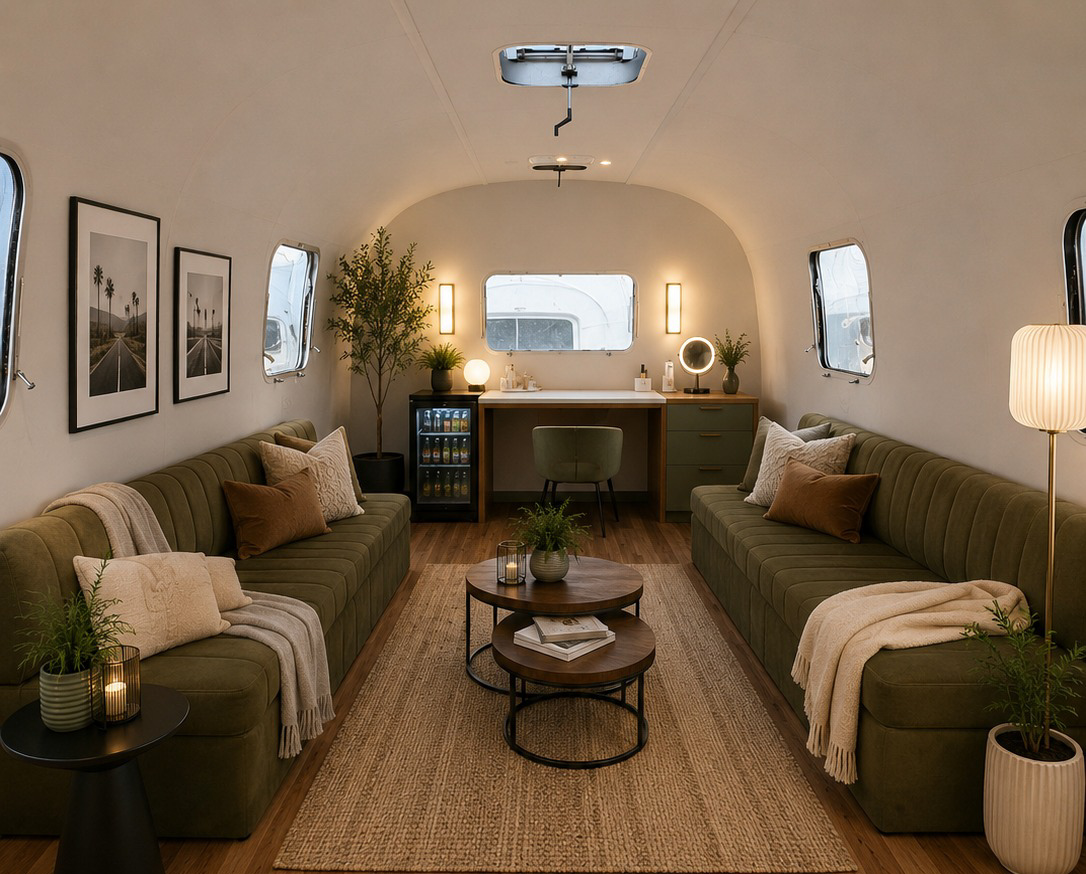
Every conference has a moment nobody plans for. Your keynote speaker arrives ninety minutes early, and there is nowhere to put them.
The venue offers a storage room behind the loading dock with a folding chair and a dead fluorescent tube. Or the business centre, which is booked. Or, most often, a curtained-off corner of the expo hall where the person about to address eight hundred people can hear every word of the sound check.
This is the green room problem, and it is bigger than a comfort issue. How you hold someone before they go on stage shapes how they perform, and for paid talent it shapes whether they come back.
Convention centres are built for volume. Halls, breakouts, registration flow. Private, quiet, finished space for small numbers of important people is the one thing they are not designed to provide.
What you typically get:
A back-of-house room that was never meant to be seen, with no natural light and a door onto a service corridor.
A breakout room that is fine acoustically but reads as a classroom, and costs a slot you would rather sell.
A pipe-and-drape build on the floor, which takes a day to install, a day to strike, has no ceiling, no lock, and no sound separation from anything.
None of these are disasters. They are just a long way below the standard of the rest of the event, and they are the part your most valuable guests see most closely.
The reason this format has spread is that the same unit solves three different problems across a single event.
Green room and talent holding. Private, climate controlled, with a mirror, decent light and somewhere to put a garment bag. Speakers prepare, artists change, executives take the call they need to take before going on.
VIP and sponsor hospitality. During the day it becomes the place you bring a prospect, an investor or a journalist. A conversation in a quiet, well-designed room lands differently from one shouted across a booth.
Private meetings. Trade show floors are the worst possible environment for a confidential conversation, and most booths offer nothing beyond a high table. A lockable room forty feet from your stand changes what you can do on the floor.
The scheduling works because the three uses rarely collide. Talent holding clusters around session times. Hospitality fills the gaps.
A built set is the obvious alternative, and it loses on four counts.
Time. A temporary room needs a build day and a strike day, and both fall inside your venue rental. An Airstream is towed in finished. Load-in to ready is measured in hours.
It is actually private. Drape is not a wall. It has no ceiling, no door and no lock, and everything said inside is audible outside. An Airstream has a real door that closes, real walls and real insulation.
It is self-contained. Climate control, lighting, seating and power are already in it. You are not negotiating with the venue for an HVAC zone in a room that was never conditioned.
It photographs. This is not a vanity point. Your speakers and sponsors will take pictures of where they were kept, and they will post them. A back office produces nothing. A polished aluminium interior produces content every day of the event, made by the people you most want talking about you.
That last one is the difference between a cost line and a marketing asset.
Most people assume a vehicle means outdoors. It does not have to.
Convention centres drive vehicles onto exhibit floors routinely, and the conditions are standard rather than negotiable. Expect the fire marshal to require a quarter tank of fuel or less, a taped or locked fuel cap, the battery disconnected, drip pans underneath, and no engine running at any point.
The practical consequence is that once the vehicle is positioned it cannot draw anything from itself. Power comes from the venue or from a battery system on board. Generators are not happening indoors.
Three things decide feasibility, and they should be settled before anyone signs anything:
Door and corridor width on the route from the loading dock to the position. This is the constraint that kills most indoor placements, and it is a measurement, not an opinion.
Floor loading, particularly on upper levels and over parking structures.
Load-in window, which at a convention centre is narrow and shared with everyone else.
If the answer indoors is no, the parking lot, courtyard or lawn usually works and comes with fewer rules.
Having done a number of these, the difference between one that works and one that is merely nice is all in the detail.
Light you can get ready in. Overhead light alone is unusable for anyone checking how they look before going on camera. A proper mirror with even front lighting matters more than almost anything else in the room.
Quiet. If the air conditioning is loud, nobody can take a call, and the room fails at one of its three jobs. Worth asking specifically.
Somewhere to hang clothing. Obvious, forgotten constantly. People arrive with garment bags.
A lockable space. Talent leave bags, laptops and phones behind when they go on. Somewhere that locks is the difference between a green room and a waiting area.
Connectivity you control. Venue wifi in a full hall is not reliable, and your speaker's last-minute slide change depends on it.
A catering drop point that does not involve someone walking through the room mid-conversation.
The usual placements, roughly in order of how often they work:
Directly outside the main entrance, where it doubles as signage and hospitality.
The venue's courtyard or plaza, if it has one, which tends to be the nicest option and the one nobody thinks to ask for.
The loading dock apron, which is unglamorous but close to backstage and often the fastest route for talent.
On the exhibit floor itself, subject to the conditions above.
A hotel forecourt, if your speakers are staying on site and you want them held before they travel.
Lead time is the thing most teams get wrong. A vehicle has to be reserved, wrapped or dressed if you want it branded, and scheduled around a venue load-in window that may be a single four-hour slot. Four to six weeks is comfortable. Two is possible and limits your options.
When you enquire, the details that actually determine feasibility and price are: the venue and whether placement is indoors or out, the dates including load-in and strike, how many people need to be in the room at once, whether you need it branded, and what power is available at the position.
Planning an event and short a green room? We supply Airstreams and vintage vehicles as lounges, green rooms and private meeting spaces for corporate events across California and Nevada, including the venue and fire marshal side of it. Tell us about your event and we reply within two hours.