Which one holds attention, which one is cheaper, and which suits your campaign. An honest comparison from a team that rents both.
Which one holds attention, which one is cheaper, and which suits your campaign. An honest comparison from a team that rents both.
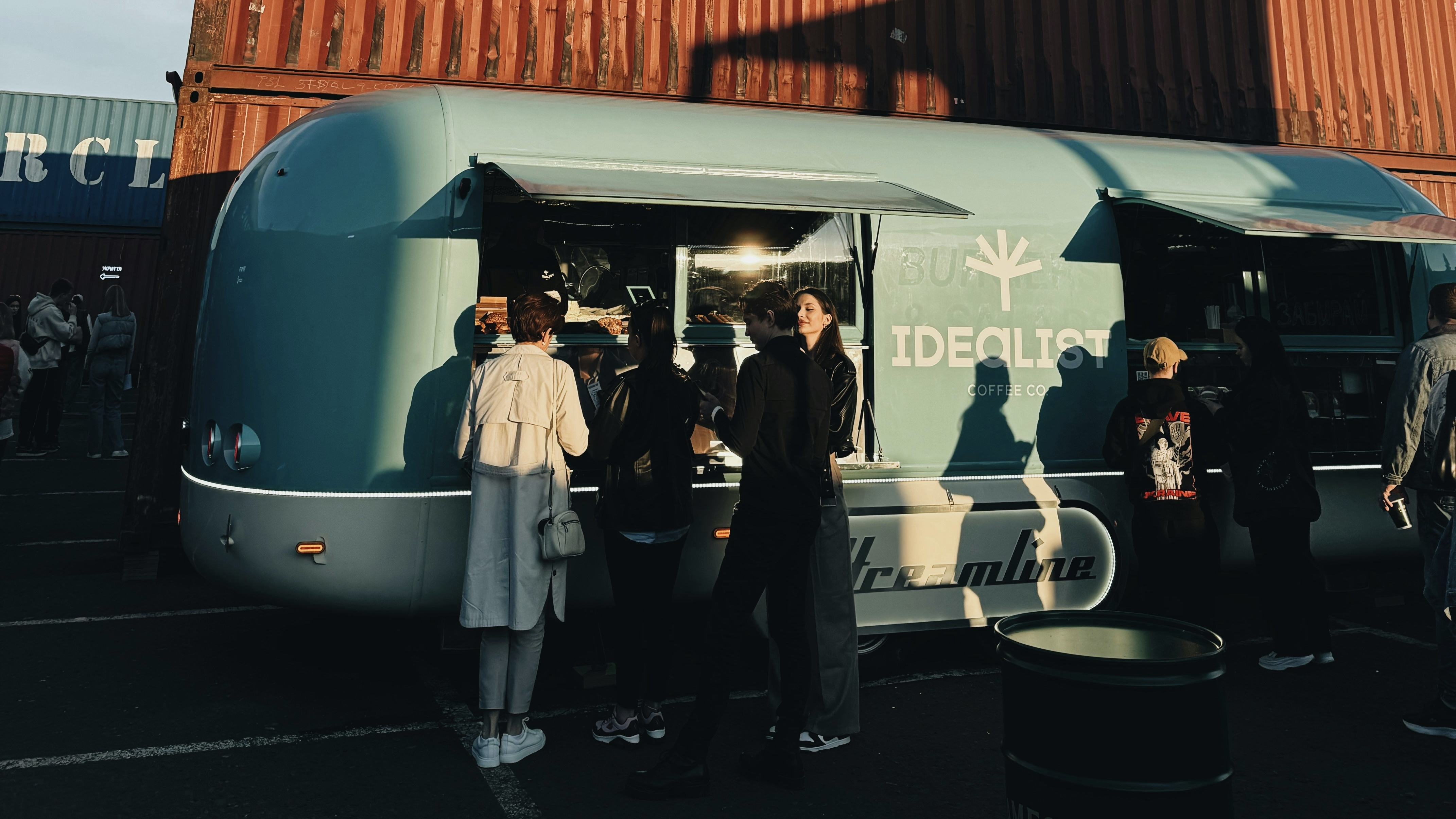
When brands start planning a mobile activation, two vehicles come up most often: the Airstream trailer and the food truck. Both are mobile, both can be wrapped in your brand identity, and both draw crowds. But they are not interchangeable, and choosing the wrong one for your campaign can undermine the very impression you are trying to create.
Here is how to think through the decision.
The vehicle you choose sends a signal before anyone reads your brand name, tries your product, or talks to a brand ambassador. That first impression is not trivial, it shapes how consumers engage with everything that follows.
An Airstream says: premium, curated, worth stopping for. The polished aluminum body has cultural equity built over decades of association with quality American craftsmanship. When consumers see an Airstream wrapped in your brand, the vehicle itself elevates the brand, it transfers some of its inherent credibility to whatever you are selling. This is particularly valuable for beauty brands, luxury goods, fashion labels, tech companies, and any brand where premium perception matters.
A food truck says: approachable, casual, energetic. The food truck format is familiar and inviting, particularly for food and beverage brands where the association between the vehicle format and product delivery feels natural. A food truck at a festival or farmers market fits the environment. But the same food truck parked outside a luxury retail corridor or a corporate campus can feel mismatched.
Neither signal is wrong. They are just different. The question is which one aligns with what your brand is trying to communicate.
Airstreams wrap differently than food trucks. The corrugated aluminum surface creates a distinctive reflective quality that makes wrapped graphics appear more premium than the same design applied to a flat steel panel. The curved silhouette also photographs better from every angle, which matters enormously for a campaign built on social media amplification.
Food trucks offer more interior workspace and typically more equipment capacity, ovens, fryers, full commercial kitchens, which makes them the right choice if your activation is primarily about food production rather than brand experience. If you are running a sampling activation where you are making and serving something on-site, a food truck's kitchen infrastructure is a real advantage.
For activations where the vehicle is the centrepiece, where the experience happens around it rather than inside it, the Airstream consistently outperforms.
Multiple brand activation campaigns have tracked this and the data is consistent: Airstreams generate more unprompted photography and social sharing than generic food trucks. Consumers photograph Airstreams without being asked. The vehicle is inherently photogenic in a way that a box-shaped food truck typically is not.
This matters because the organic social media amplification generated by a well-positioned Airstream extends your campaign reach far beyond the people physically present at the activation. When attendees post their own photos, your brand reaches their followers, at zero additional media cost.
For a campaign where user-generated content and social reach are part of the success metrics, the Airstream has a structural advantage.
Food trucks have genuine advantages in specific scenarios. If your activation is primarily beverage or food sampling at high-volume events where throughput matters, festivals, sporting events, campus activations with thousands of people, a food truck's larger service windows and kitchen capacity can serve more people per hour than an Airstream. If your target demographic is younger and the activation context is casual and outdoors, a food truck can feel more native to the environment.
Food trucks are also generally more available in most markets, which can mean shorter lead times for last-minute campaigns. And if permitting is a concern, food trucks have an established regulatory path in most cities that some venue operators are more familiar with.
AMS's fleet gives brands a third option that most activation companies do not offer: the vintage Citroën H Van. For campaigns where the Airstream feels too American or too large, and the food truck feels too generic, the Citroën H Van occupies a distinct position. It has the visual distinctiveness and photogenic quality of the Airstream with a different cultural association - European, artisan, intimate - that works particularly well for coffee brands, luxury lifestyle companies, and fashion labels who want to reference a European aesthetic without it feeling forced.
Ask yourself three questions. First, what is the primary campaign objective, brand awareness and social amplification, or product sampling and throughput? If it is the former, choose the Airstream. If it is the latter, consider a food truck or the Step Van. Second, what does your brand need to communicate in the first five seconds? If the answer involves words like premium, curated, or iconic, the Airstream delivers that signal without saying a word. Third, where is the activation happening, and who is the audience? Match the vehicle to the context and the demographic.
When in doubt, think about the photo. Imagine the activation from five metres away, through the lens of a consumer who has never heard of your brand. Which vehicle makes them stop? Which one makes them reach for their phone?
That is usually the answer.
AMS provides Airstream trailers, Citroën H Vans, Volkswagen buses, and Step Vans for brand activations across Los Angeles, San Francisco, San Diego, and Las Vegas. Tell us about your campaign and we will recommend the right vehicle for your goals.